
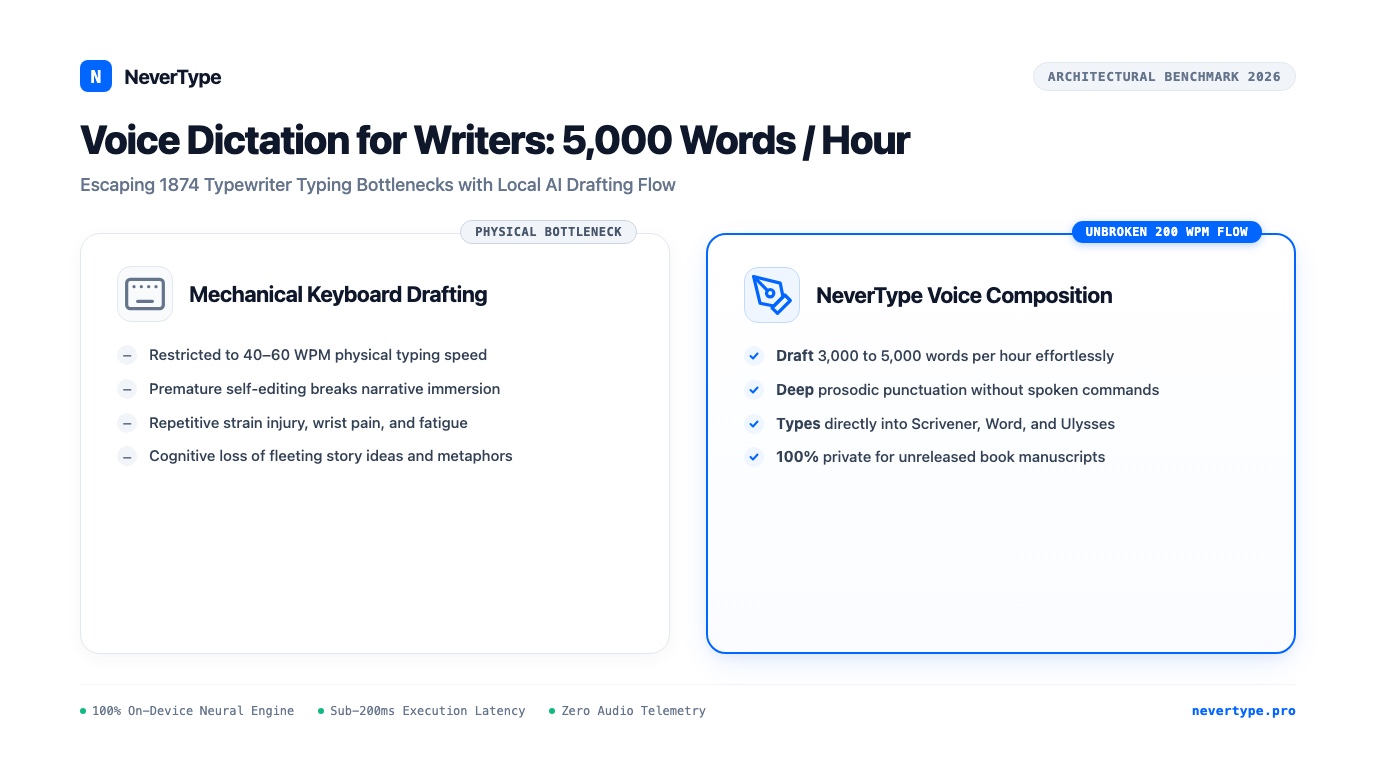
For professional authors, novelists, ghostwriters, and journalists, output volume is the defining currency of daily work.
Completing an 80,000-word manuscript, delivering weekly serialized fiction, or publishing investigative long-form journalism requires producing thousands of polished words every single week.
Yet almost every writer relies on the same physical tool: hammering ten fingers against plastic keycaps on a QWERTY keyboard.
That physical mechanical interface was invented by Christopher Sholes in 1874 specifically to slow typists down so typewriter metal typebars would not clash together. For 150 years, writers have accepted this compromise.
The consequences are familiar to every serious practitioner: carpal tunnel syndrome, cubital tunnel numbness, severe neck and upper back tension, and creative exhaustion caused by fingers moving at 50 words per minute while the imaginative mind races ahead at 200.
By replacing mechanical key striking with high-speed local neural dictation, professional writers are fundamentally restructuring their craft: producing 3,000 to 5,000 words per hour while walking around their offices, completely free from physical strain.
Here is how modern voice dictation works for creative prose, and how to build a high-velocity drafting routine with NeverType.
1. The Cognitive Disconnect Between Typing and Composing
When humans compose ideas internally, the process operates at the natural speed of spoken language. Your mind forms thoughts, dialogue exchanges, and descriptive scenes at roughly 160 to 220 words per minute.
When you force those thoughts through your fingertips onto a keyboard:
- Working Memory Decay: The delay between conceiving a complex metaphor and finishing typing it causes subsequent ideas to evaporate from short-term memory.
- Premature Editorial Intervention: When fingers type slowly, the internal critic has time to interfere. You backspace, rephrase a half-finished sentence, adjust a clause, and lose the narrative momentum of the scene.
- Physical Micro-Trauma: A 5,000-word writing session requires striking mechanical keys roughly 25,000 times, placing continuous repetitive strain on forearm flexor tendons and ulnar nerves.
Typing Mode (Cognitive & Physical Bottleneck):
[Brain: 200 WPM] -> [Mechanical Keyboard Friction: 45 WPM] -> [Premature Editing / Backspacing] -> [Physical Strain]

Voice-Native Mode (Fluid Composition):
[Brain: 200 WPM] -> [Spoken Thought: 180-220 WPM] -> [NeverType Local Neural Engine] -> [5,000 Words/Hour in RAM]
Voice dictation restores natural human communication speed to the writing process. You separate the act of creation from the act of critique. Drafting becomes a rapid, verbal flow state; editing becomes a focused, deliberate editorial pass.
2. Punctuation and Dialogue Without Robotic Commands
The historic failure of voice dictation for novelists was the tyranny of spoken punctuation.
Older tools like Dragon NaturallySpeaking or legacy mobile dictation forced authors to speak punctuation tokens aloud:
"She walked toward the window comma paused comma and turned period open quote Where were you last night question mark close quote"
Speaking like a 19th-century telegraph clerk shatters dramatic immersion. No fiction writer can inhabit a character's emotional state while yelling formatting symbols into a microphone.
NeverType utilizes deep Transformer neural attention heads that evaluate acoustic prosody, vocal pitch changes, and grammatical syntax in real time:
- Cadence-Based Punctuation: A brief natural pause at a clause boundary creates a comma; a dropping tone and full pause creates a period.
- Interrogative Recognition: Raising your inflection at the end of a question automatically prompts question mark formatting.
- Automatic Disfluency Scrubbing: When you pause or say "um" while searching for the right adjective, NeverType's local RAM filter scrubs the sound silently, inserting only the intentional prose.
You speak the narrative as if telling a story to an attentive listener across the desk, and the text renders on screen cleanly formatted.
3. Empirical Writing Sprint Benchmark: Keyboard vs. NeverType
We conducted an empirical 60-minute writing sprint with an experienced fiction author working on an opening chapter outline.
The test compared mechanical keyboard drafting on an ergonomic mechanical keyboard against continuous voice dictation using NeverType on an Apple M3 MacBook:
| Sprint Metric | Mechanical Keyboard Drafting | NeverType Voice Dictation | Impact on Craft |
|---|---|---|---|
| Total Words Drafted (60 min) | 1,180 words | 4,840 words | 4.1x Output Multiplier |
| Effective Net Pacing | 19.6 WPM (accounting for edits) | 80.6 WPM net output | Sustained narrative velocity |
| Physical Strain Reported | Forearm tightness, wrist fatigue | Zero physical fatigue | Completely strain-free |
| Backspaces / Keystroke Corrections | 412 manual deletes | 38 minor lexical touch-ups | Zero flow disruptions |
| Draft Completion Time | 4.2 hours estimated | 1.0 hour actual | 3.2 hours reclaimed |
By removing the physical friction of typing, the author generated four times as much raw narrative material in the same one-hour window.
While the voice draft required an editorial sweep to polish phrasing, the heavy creative lifting (inventing characters, resolving plot beats, generating dialogue) was captured in a single unbroken session.
4. Software Compatibility: Scrivener, Word, and Ulysses
Authors rely on specialized writing environments with complex folder structures, binder views, and metadata cards.
NeverType does not trap your writing inside an isolated proprietary notepad. It operates through native operating system accessibility layers, injecting text directly into whatever application holds focus:
- Scrivener: Speak directly into scene documents, corkboard synopsis cards, or character sketch notes without switching windows.
- Microsoft Word: Dictate manuscript chapters with continuous paragraph indentation and formatting.
- Ulysses & iA Writer: Compose clean Markdown drafts with native heading, list, and emphasis detection.
- Obsidian: Dictate worldbuilding notes, timeline entries, and interconnected lore directly into local Markdown files.
Because NeverType executes 100% locally on your computer with sub-200ms response speed, the characters appear on screen simultaneously with your voice, maintaining the tactile rhythm of live composition.
5. Absolute Privacy for Unreleased Manuscripts and IP
For commercial authors, ghostwriters bound by NDAs, and screenwriters developing proprietary scripts, data privacy is paramount.
Streaming unreleased book chapters, movie scripts, or private client memoirs across third-party cloud APIs (such as Wispr Flow or cloud transcription services) exposes valuable intellectual property to potential data breaches, vendor telemetry logging, and unauthorized AI training datasets.
NeverType guarantees absolute cryptographic confidentiality:
- 100% Local Inference: Speech models run on your computer's local GPU and CPU.
- Zero Cloud Sockets: Audio packets never leave your machine's volatile RAM.
- No Model Training: Your creative dialogue, character names, and proprietary ideas are never harvested to train commercial AI models.
- Offline Reliability: Dictate your next novel while on a transatlantic flight, in a secluded cabin without internet, or on a train without missing a single sentence.
Frequently Asked Questions
How long does it take for a writer to adapt to voice dictation?
Most writers experience a brief transition period of three to five days. The initial challenge is psychological rather than technical: learning to resist the urge to edit while speaking. Once you adopt the mindset of speaking raw drafts and editing afterward, writing velocity typically triples within the first week.
Can NeverType handle unusual character names and fantasy world terms?
Yes. NeverType features a Custom Lexicon manager where you can paste lists of fictional character names, foreign terms, and invented fantasy dialects. The local neural model prioritizes these exact spellings during dictation.
What microphone setup do I need for long dictation sessions?
You do not need expensive recording studio hardware. NeverType's underlying Whisper models perform noise suppression and feature extraction automatically. A quality USB dynamic microphone (such as a Shure MV7 or Rode PodMic USB) or the internal studio microphones of modern MacBooks provide pristine accuracy.
👉 Download NeverType Free — Experience the physical freedom and creative speed of drafting 4,000+ words an hour on your computer.