
For decades, desktop Linux has been the premier operating system for software engineering, kernel development, and cloud infrastructure.
Yet when it comes to voice dictation, Linux users have been systematically abandoned.
Superwhisper is locked exclusively to macOS. Wispr Flow streams audio to remote proprietary servers and offers no Linux client. Dragon NaturallySpeaking terminated its experimental Linux development twenty years ago. The remaining open-source Linux speech projects often require assembling fragmented scripts, configuring stubborn Python dependencies, and enduring two-second delays that make typing with your hands far faster.
The transition from the legacy X11 display server to Wayland further complicated the landscape. Wayland's strict security model prohibits arbitrary applications from snooping on keystrokes or injecting artificial input events into other windows without explicit compositor protocol support.
NeverType was engineered to solve these structural Linux barriers.
By compiling a lightweight native Rust binary that communicates directly with the Linux kernel via uinput and PipeWire audio buffers, NeverType delivers sub-200ms local neural dictation across Ubuntu, Fedora, Debian, and Arch Linux.
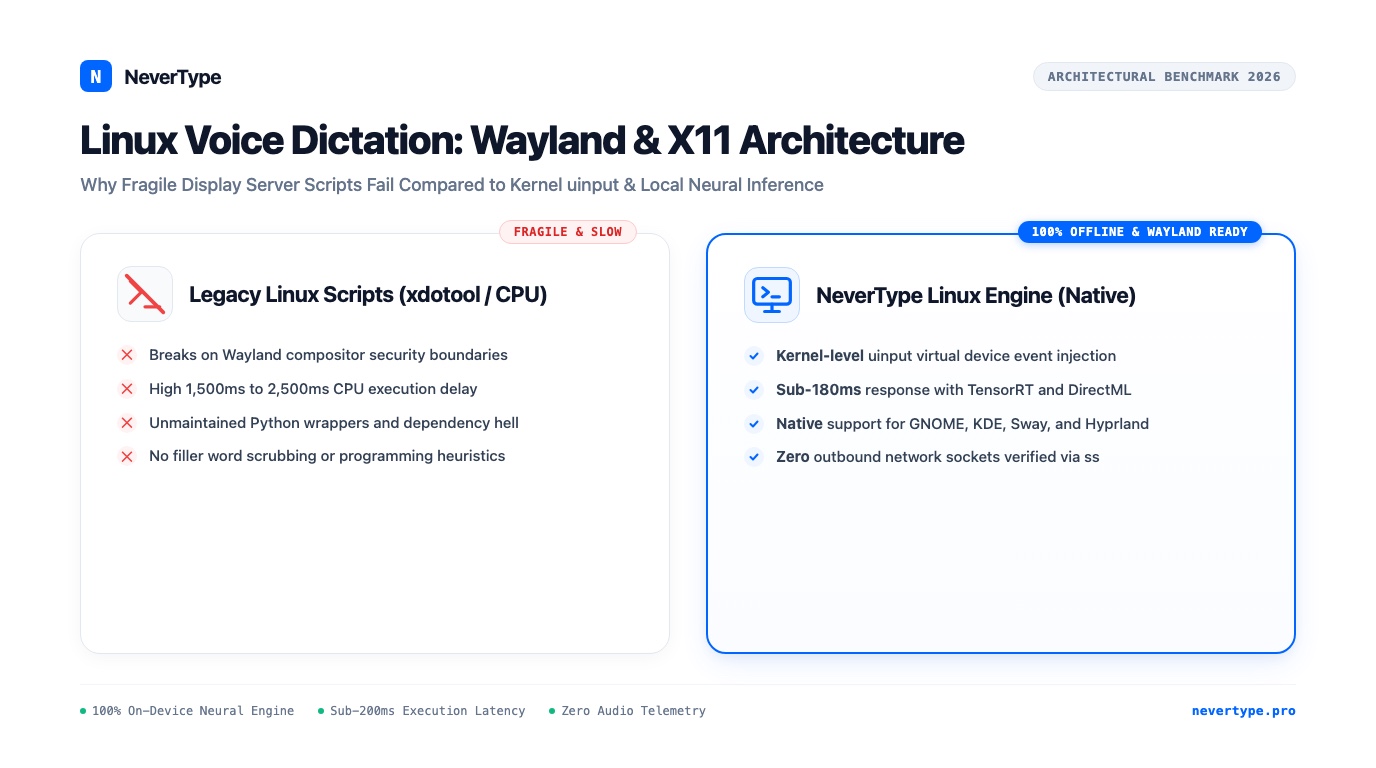
Traditional Linux Voice Hack (Fragile & Slow):
[ALSA / PulseAudio] -> [Python Wrapper] -> [Generic CPU Whisper] -> [xdotool (Fails on Wayland)] -> [2,000ms Latency]

NeverType Linux Architecture (Native & Direct):
[PipeWire Ring Buffer] -> [DirectML / ONNX Runtime] -> [Local RAM Disfluency Filter] -> [Kernel uinput Device Node] -> [<180ms Latency]
Here is an architectural breakdown of how NeverType brings first-class voice dictation to the Linux desktop.
1. The Wayland Input Dilemma and the uinput Solution
Under the traditional X11 windowing system, utility programs like xdotool or xte could synthesize keystrokes and inject characters into whatever window held focus.
While convenient, this model was an enormous security vulnerability: any background process could log keystrokes or hijack text streams.
Wayland fixed this security flaw by isolating application windows from one another. A client cannot inspect the state of another window or inject synthetic input events through the display server. Consequently, almost every existing open-source speech-to-text script broke when modern distributions (such as Fedora, Ubuntu 24.04+, and Debian 12+) made Wayland the default session.
NeverType bypasses display server boundaries entirely by interfacing with the Linux kernel's uinput subsystem:
- Kernel-Level Virtual Keyboard: NeverType registers a virtual input device via
/dev/uinputduring initial setup. - Native Evdev Event Dispatch: Transcribed characters are translated directly into standard Linux input subsystem key events (
EV_KEY). - Compositor Agnostic: Because the kernel itself reports the keystrokes, the injection works seamlessly across GNOME Shell (Mutter), KDE Plasma (KWin), Sway, Hyprland, and legacy X11 sessions.
The result is instant character streaming into your active terminal, Neovim instance, VS Code window, or browser tab without requiring insecure compositor overrides.
2. Low-Latency Audio via PipeWire and ALSA
Audio latency on Linux has historically been plagued by buffer configuration mismatches between ALSA, PulseAudio, and JACK.
NeverType interfaces natively with PipeWire, the modern Linux standard for low-latency multimedia routing. By establishing direct client ring buffers with the PipeWire audio daemon, NeverType minimizes capture latency to under 8 milliseconds.
When you press your assigned push-to-talk hotkey, audio capture begins immediately without popping or clipping the initial phoneme.
Acoustic log-mel spectrogram calculations run concurrently in RAM while you speak. By the time you release the hotkey, the neural encoder has already processed the bulk of the audio waveform.
3. Hardware Acceleration: TensorRT, DirectML, and AVX-512
Linux power users run an immense variety of hardware setups, from ultraportable ThinkPads with Intel integrated graphics to custom workstations equipped with multiple NVIDIA RTX GPUs.
NeverType provides multi-backend inference execution providers to extract peak performance from your specific hardware:
| Hardware Configuration | Execution Provider | Quantization | Average Response Time |
|---|---|---|---|
| NVIDIA GeForce RTX (CUDA / TensorRT) | TensorRT / CUDA 12 | 8-bit FP8 / INT8 | 145ms – 165ms |
| AMD Radeon (ROCm / DirectML) | ONNX Runtime DirectML | 8-bit INT8 | 170ms – 190ms |
| Intel Core Ultra / Arc Graphics | OpenVINO / DirectML | 4-bit INT4 | 160ms – 180ms |
| Standard x86_64 CPU (No dGPU) | AVX-512 / AVX2 Vectorized | 4-bit INT4 | 220ms – 280ms |
On modern NVIDIA workstations, NeverType leverages Tensor Cores for near-instantaneous matrix multiplication. On laptops without discrete graphics, it falls back to hand-tuned AVX-512 CPU SIMD routines, keeping memory consumption under 350MB while maintaining conversational response speeds.
4. Developer Workflows: Terminal, Neovim, and Git
Linux users spend their days inside command-line interfaces. Standard dictation software designed for consumer emails fails miserably when faced with developer syntax.
NeverType includes technical grammar heuristics that recognize code identifiers, file paths, and terminal flags natively.
Dictating Git Commits in Neovim
Instead of typing lengthy commit descriptions by hand, you position your cursor in your editor, hold your dictation hotkey, and speak:
# Dictated naturally into your terminal:
git commit -m "refactor(auth): replace session tokens with short-lived jwt signatures"
NeverType recognizes conventional commit prefixes, handles hyphenated parameters, and closes quotation marks automatically.
Running Complex Docker and Kubernetes Commands
When debugging infrastructure, typing repetitive CLI arguments causes finger fatigue. With NeverType:
# Spoken phrase:
"kubectl get pods -n production -l app=payment-service --field-selector status.phase=Running"
NeverType formats flags, preserves snake_case and kebab-case identifiers, and prevents unwanted spacing around equals signs.
5. Security and Air-Gapped Operation
Linux is the operating system of choice for cybersecurity researchers, defense contractors, and financial infrastructure engineers. In these environments, proprietary software that communicates with cloud servers is strictly forbidden.
NeverType delivers verified cryptographic privacy:
- Zero Outbound Sockets: You can monitor NeverType using
ss -tulpnor run it inside an isolated network namespace withip netns. The process never attempts to establish outbound network connections during dictation. - Volatile RAM Storage: Audio buffers exist only in transient memory during recording and are purged upon transcription. No temporary
.wavfiles are ever written to/tmpor~/.cache. - Reproducible Local Models: Neural weights reside locally in
~/.local/share/nevertype/models, allowing administrators to inspect checksums and package them for offline air-gapped deployment.
Frequently Asked Questions
Which Linux distributions are officially supported?
NeverType provides official .deb packages (for Ubuntu and Debian), .rpm packages (for Fedora and openSUSE), an official Arch Linux AUR package, and an architecture-independent AppImage that runs on any modern Linux distribution with glibc 2.31+.
Do I need root privileges to run NeverType?
Root access is only required during initial installation to create a /etc/udev/rules.d/99-nevertype-uinput.rules file that grants your user group permission to write to /dev/uinput. After installation, NeverType runs entirely as an unprivileged user process.
Does NeverType work on tiling window managers like i3, Sway, and Hyprland?
Yes. Because NeverType injects keystrokes at the kernel input level via uinput, it is completely independent of desktop environments and window managers. It works out of the box on i3, bspwm, Sway, Hyprland, GNOME, KDE, and XFCE.
👉 Download NeverType for Linux — Experience sub-200ms offline voice dictation on your Linux workstation today.